Sunday, August 21

Rooster's Crow

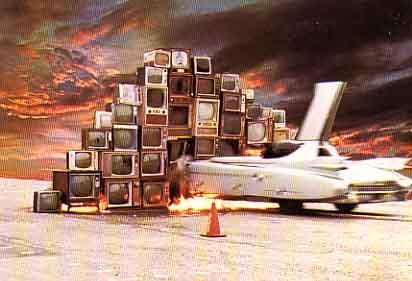
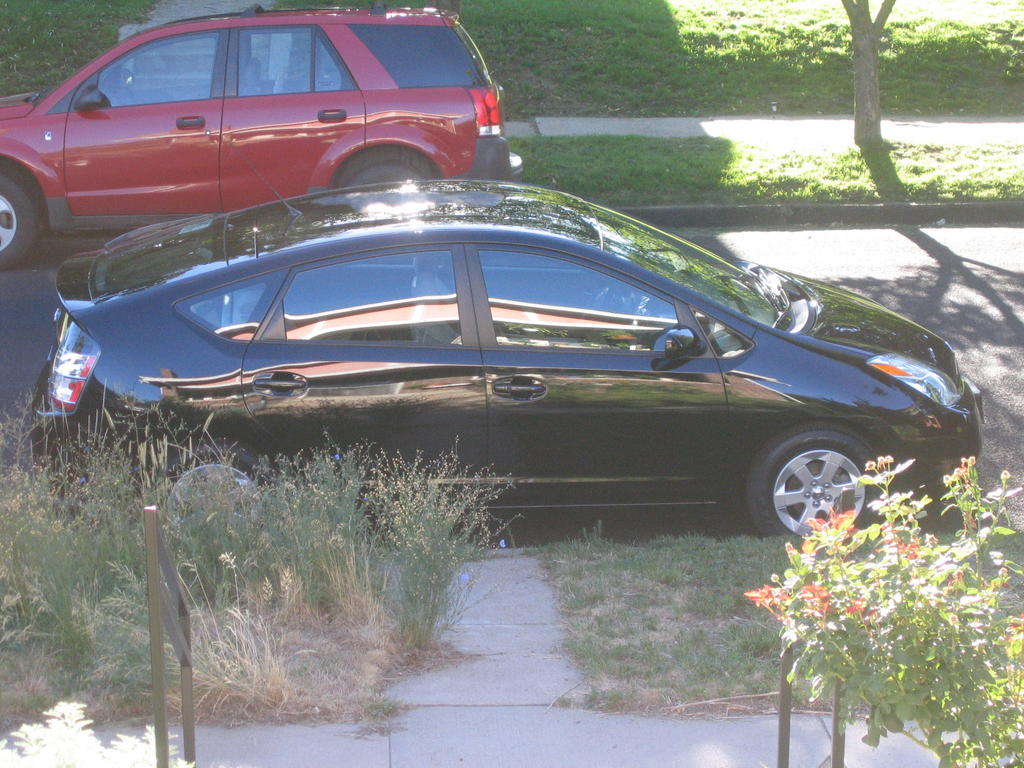
the new Williams Chariot waits to build upon its 14 young miles...

Following the seismic ponderments of the last few months, my clan(Beth, Sugi, and I) have voted to delay an expedition to another hemisphere in order to pursue goals here and now. Following promotions and a brief consideration of homebuying, we've elected to invest in a new Toyota Prius, which we picked out this week. Lifeways, Beth has burgeoning projects in dance etc., and Jesse is focusing on graduation. These babies require concentration and a great deal of effort that has been siphoned recently by planning and consideration on the there. So, we now've elected to dig a little deeper and pollute a lot less...

Our Suburu workhorse got about 22mpg, overcame rutted Colorado 4wd roads and put up with many adventures, but the benefits of trading her for this lovely(above) were overwhelming(below). Getting two to three times the mileage, we envision a reinvestment of sorts in the next coupla years here in Lala-land.

Excellent source of info:http://www.hybridcars.com/index.html

From Autoblog 2004:
USA: Hybrid gets top crash test rating
The first hybrid car to be crash-tested by Euro NCAP, the Toyota Prius, was one of eight cars to achieve the top five star occupant rating and also received the highest rating for child protection.
From Consumer Reports:
Highs:
Fuel economy, low emissions, transmission, ride, hatchback versatility, reliability.
Lows:
Steering feel, multifunction display.
Toyota's second-generation Prius is unbeatable for its combination of economy, acceleration, and interior room. It couples a 1.5-liter gasoline engine with an electric motor, and it automatically switches between them or runs on both as needed. The car shuts the engine off at idle. We got an excellent 44 mpg overall in our tests. Shifts are automatic via a responsive continuously variable transmission (CVT). Regenerative braking recharges the battery while coasting or braking. Ride and handing are competent, though the steering feels vague. Access is easy. Reliability has been outstanding.

From Internet Auto Guide:
2005 Toyota Prius
This is now a midsize car. It's roomy, with adult-size back seats and lots of cargo space. And it's also more pleasant to look at, with sleek, futuristic styling. It's easy to spot in a crowded grocery store parking lot.
The real justification to buy a Prius is its extremely low emissions. It produces almost no pollution and is one of the most environmentally friendly vehicles you can drive. The Prius is an excellent choice for buyers who want to reduce air pollution and America's dependence on oil. The Prius isn't cheap, but it's an amazing piece of engineering that achieves those goals.
Check the list of standard equipment, and you'll see that the word "economy" applies only to
Safety is enhanced with antilock brakes (ABS), Electronic Brake-force Distribution (EBD), Brake Assist, and traction control. Standard passive safety features include multi-stage, dual front airbags; three-point seatbelts and head restraints at all five seating positions; and rear seat head restraints that are adjustable. Curtain airbags designed to offer head protection for front and rear passengers and seat-mounted side-impact airbags for torso protection for driver and front-seat passenger.
The side view makes clear the stylists' devotion to aerodynamics. A steeply raked windshield carries the hood's acute angle rearward. An even more steeply raked backlight (rear windscreen) ends in a high spoiler that trips the air stream as it leaves the car, maximizing the aero advantage of the car's almost-vertical back end. Sleek rear quarter windows do more to visually enhance the aerodynamic look than they do for outward visibility.
A tall glasshouse yields exemplary outward visibility. As is the case with many of the latest aerodynamic designs, the driver can't see the front of the car or the hood without leaning forward.
Driving Impressions
By complementing the gasoline engine's horsepower with the electric motor's torque, the Prius makes better use of the energy stored in each gallon of gasoline, while leaving fewer nasty chemical compounds in its wake. The electric motor, which begins cranking out its maximum torque virtually the moment it starts spinning, gets the car moving and helps it accelerate while it's underway. The gasoline engine steps to the fore at more constant speeds, especially during highway driving, where horsepower is more critical for maintaining a car's momentum.
The hybrid system improves fuel economy further by turning off the gasoline engine when it's not needed, like when you are waiting at a stop light or even when puttering around town at low speeds. Any time the driver's right foot requests more motivation than the electric motor alone can provide, the gasoline engine fires up and joins in.
The transmission is non-traditional, too, though not unique in today's market. Prius uses a continuously variable transmission, which shuns gears for a steel-segmented belt riding on variable-diameter pulleys. This system constantly and automatically selects the most efficient drive ratio to get the car moving and to keep it moving.
Emissions are the lowest of any real car available to U.S. buyers. On the surface, it is bettered by electric cars, but electric cars are impractical and must be recharged using another energy source that, in turn, requires fuel. So in the big picture, the Prius is easier on the environment than electric cars are.
The Prius saves fuel and reduces emisions by scavenging energy that most cars waste. Regenerative braking links the brakes to a generator, helping use the car's kinetic energy to recharge the battery whenever the brakes are applied. Along the same lines, the transmission offers a setting that helps recharge the battery when the driver merely lifts off the accelerator and lets the car coast, most beneficially downhill. In sum, with all these regenerative methodologies, there's no need (and no way, for that matter) to plug the car into an electrical outlet to charge the battery.
Final Word
The Toyota Prius sets the standard for environmentally friendly transportation. It also delivers extremely good fuel efficiency for a four-seat car with an automatic transmission. Just ignore those EPA numbers. Buyers can expect to average something north of 45 mpg.

Saturday, August 20

Rate Your State!

http://www.surveyusa.com/50StatePOTUS0805.htm

Eight cities in Texas are competing with each other to be the location for the George Bush Library. It's BYOB -- bring you own books. ... The George Bush Presidential Library -- that shouldn't take up too much space: a box of cliff notes and pop-up books. . . The only thing Bush ever checked out of a library was Laura. -- Jay Leno

Friday, August 19

$5 a gallon

U.S. author forecasts $5 gas by next year
CHICAGO, Aug. 17 (UPI) -- An oil expert and author who correctly forecast $3 per gallon gasoline in the United States this year says the price will reach $5 next year.
Craig Smith, author of "Black Gold Stranglehold," told the Chicago Sun-Times there's also a possibility the price could hit $10 per gallon if terrorists strike a major Middle East oil field.
Last year, Smith predicted $3-a-gallon gas and $65-a-barrel crude oil prices this year, and now says oil prices will jump to $80 a gallon by the end of 2006.
Meanwhile, he said complaining about the current spike makes no sense.
"Why are they charging higher prices for gas? Because people will pay it," he told the Sun-Times.

NYT editorial: The Oil Effect
(G)as is now averaging $2.60 a gallon nationwide, nearly a 39 percent increase from last year. At the same time, natural gas prices are up 60 percent to 90 percent around the country, presaging steep home-heating bills in the months ahead on top of high prices at the pump.
With most other prices relatively tame, consumers could weather the energy squeeze if they had a cushion. They don't.
Wage gains for most Americans are barely keeping up with inflation. And according to a recent Commerce Department report, Americans, on average, are now saving nothing each month, so they obviously cannot pay higher energy bills by reducing the amount they save.
That leaves rising home values to cover growing energy costs. According to a recent report by John Makin, a visiting scholar at the American Enterprise Institute in Washington, the housing boom has offset the economic drag of higher oil prices by enabling homeowners to get cash through refinancing or selling at a profit, and by creating a "wealth effect": as their houses appreciate, homeowners feel rich and thus spend freely, even as they neglect to save.
Mr. Makin estimates that a mere leveling off of housing prices would be sufficient to remove the economic boost from real estate. That would slow consumer spending and, with it, the economy.
No one knows when that leveling off will occur. But homes are already becoming increasingly unaffordable, and refinancings are slowing down. There are early signs that banks are beginning to tighten their lending standards. And the Federal Reserve, which has been trying for more than a year to push up mortgage rates, will probably succeed in that endeavor at some point.
The pain that now seems imminent might have been avoided. Conservation could have reduced energy demand and prices, while properly targeted job growth and savings incentives - not tax cuts for the rich - could have built a stronger job recovery, helping to foster higher wages and new savings. Maybe next time around.

And: World running out of time for oil alternatives
http://www.breitbart.com/news/2005/08/18/MTFH69017_2005-08-18_13-53-52_SCH850008.html
Time to go look at a hybrid.....

Cincinnati Boys

http://www.cnn.com/2005/WORLD/asiapcf/08/16/cambodia.biking.ap/

Thursday, August 18

Is there anybody in there?

Well, George. Here are the likeliest replacements for your gig, and they're not on vacation:
http://news.yahoo.com/s/ap/20050818/ap_on_go_co/climate_change_alaska

Wednesday, August 17

Asses

"What we expected to achieve [in Iraq] was never realistic given the timetable or what unfolded on the ground."
—A senior Bush administration official involved in policy since the 2003 invasion of Iraq.

http://ap.tbo.com/ap/breaking/MGB9AGBFCCE.html

State Department experts warned CENTCOM before Iraq war about lack of plans for post-war Iraq security
Planning for post-Saddam regime change began as early as October 2001
http://www.gwu.edu/%7Ensarchiv/NSAEBB/NSAEBB163/index.htm

Sunday, August 14

How would you like your Oil done?

Bets and I, having recently waethered a spate of obsessive 'whatifweboughtahouse'-ed-ness, have turned now to the logic (or not) of rolling our savings into a hybrid vehicle. Now that the general public is responding to (suddenly very real) concerns about gas costs, and the incipient questions voluntarily raised about oil, war, politics, the price of bananas, economic bubbles, climatic change, and 'stuff'; its a whole new world. Truthfully, its been new for longer than programming and our careers would allow. But perhaps clarity meets us more often than in the past at the gas pump.
So, I think the Prius is a worthy vehicle, especially considering the quite real possibility of $5.00 a gallon. And now that the monolithic auto industry is beginning to explore the profit possibilities in hybridized fleets, american consumers no doubt can chart a new course.
Which reminds me of the most recent book to delight me. Ronald Wright's A Short History of Progress is a much less than 200 page summation of human/bipedal culture and history as it pertains to where we stand in the Cosmos today. If you (may) find yourself outside the 'Jesus Gonna Be Here Soon' camp, thereby omitting the divine salvation/happy ending COP-OUT that gives license to all-sort of curious behavior, this book I highly recommend.
Excerpts:
"Despite certain events in the twentieth century, most people in the Western cultural tradition still believe in the Victorian ideal of progress, a belief succinctly defined by the historian Sidney Pollard in 1968 as "the assumption that a pattern of change exists in the history of mankind ...that it consists of irreversible changes in one direction only, and that this direction is toward improvement."
Our practical faith in progress has ramified and hardened into an ideology- a secular religion which, like the religions that progress has challenged, is blind to certain flaws in its credentials. Progress, therefore, has become a myth in the anthropological sense."
Using the best of scientific and historical analysis from the last century, as well as breaking news 'about Your World, for You, Right Now' in political, cultural, and environmental patterns Wright connects the dots in a world become increasingly frenetic and distracted. Do read!

Thursday, August 11

If peak oil is a myth,

Is big oil now admitting the problem?

http://www.tompaine.com/articles/20050808/the_twilight_era_of_petroleum.php

Siberia Melts: http://www.newscientist.com/channel/earth/mg18725124.500

national nutritional priorities

Feds Aren't Subsidizing Recommended Foods
August 10, 2005 1:15 PM EDT
WASHINGTON - The government says half your diet should be fruits and vegetables, but it doesn't subsidize the farmers who grow them.
Instead, half of all federal agriculture subsidies go to grain farmers, whose crops feed animals for meat, milk and eggs and become cheap ingredients in processed food.
What's wrong with that?
"Obesity. That's clearly the problem, if you look at the outcome in today's society," said Andy Fischer, executive director of the Community Food Security Coalition, a Venice, Calif., advocacy group.
Two-thirds of Americans are overweight or obese. People clearly are getting the calories they need and more, but they're not getting enough nutrition, diet and disease experts say.
The government's new food pyramid, unveiled in April by the Agriculture Department, aims to improve the nation's health. It recommends that people eat fewer calories and more fruit, vegetables, lowfat milk and whole grains. It also tells people to avoid foods made with partially hydrogenated oils and sweeteners.
Federal farm programs, on the other hand, aim to maintain the financial health of American agriculture. Subsidies encourage an abundant supply of corn, wheat, rice and soybeans. Much of the corn and soybeans is fed to livestock. Some also is turned into nutrition-poor ingredients in processed food for people. For example, toaster pastries contain partially hydrogenated soybean oil that gives them a flaky texture, and they contain high-fructose corn syrup to sweeten their fruit filling. That translates to lots of calories, lots of artery-clogging fat and little or no fiber.
Such foods are becoming progressively cheaper, while the price of fruit and vegetables is rising, said Adam Drewnowski, professor of epidemiology at the University of Washington.
"If we tell a family, you really ought to be eating more salads and fresh fruit, and this is a low-income family, we're essentially encouraging them to spend more money," Drewnowski said.
Many groups are pushing to link farm programs, which are due for an overhaul in 2007, more closely to government nutrition goals.
"Here we are as a society, talking constantly about obesity and diets, and yet our farm policies are not structured to encourage the kind of diet that the food pyramid suggests we should adopt," said Ralph Grossi, president of American Farmland Trust, a Washington-based group that advocates conservation on farm and ranch land.
Here is what the food pyramid says you should eat, based on a 2,000-calorie daily diet:
-3 cups of fat-free or lowfat milk or cheese.
-2 1/2 cups of vegetables.
-2 cups of fruit.
-6 ounces of grains.
-5 1/2 ounces of meat or beans.
Your plate would look quite different if it matched farm subsidies. Estimated to cost $17 billion this year, according to the Congressional Budget Office, the breakdown of farm subsidies includes:
-$7.3 billion for corn and other feed grains.
-$3.5 billion for cotton.
-$1.6 billion for soybeans.
-$1.5 billion for wheat.
-$1.5 billion for tobacco.
-$686 million for dairy.
-$626 million for rice.
-$271 million for peanuts.
The Agriculture Department doesn't just hand out subsidies to farmers and tell people what they should eat. It operates school lunch and food stamp programs and the Special Supplemental Nutrition Program for Women, Infants and Children, or WIC. It also runs the Forest Service and oversees land conservation efforts.
With 100,000 employees and a $95 billion annual budget that includes the farm subsidies, the department has many different objectives, said Keith Collins, the agency's chief economist.
While farm subsidies are intended to provide some income stability and financial assistance to producers, Collins said climate and market prices are much bigger factors when farmers choose what to grow.
"You're not going to find corn in California," he said. "You're not going to find wine grapes in other areas like you find them there."
He pointed out the government does help fruit and vegetable growers: They have access to federal crop insurance, and the department spends more than $400 million a year buying produce and other commodities for the school lunch program, purchasing everything from almonds and asparagus to pineapples and turkey.
Agriculture Secretary Mike Johanns has begun a series of "listening sessions" across the country to gather input for the next farm bill, which dictates how subsidies are distributed. But the department doesn't write the farm bill. Congress does.
That's where the influence of the major farm groups comes in. Groups that lobby together on behalf of subsidized crops have more than 60 years of experience under their belts.
"Those are the guys that have been together. They have been through a lot of fights on cutting funding and changing programs," said Mary Kay Thatcher, lobbyist for American Farm Bureau Federation. The federation is the nation's largest general farm organization, which has members who grow subsidized crops as well as produce.
Produce groups, on the other hand, are more loosely knit and have different interests, she said. Rather than lobby for subsidies, they've sought marketing assistance, more dollars for farmers' markets and more government purchases of fresh fruit for schools.
"We don't want to be subsidized, we want our industry to get its fair share of federal support," said Tom Nassif, president of Western Growers Association, which represents fruit, vegetable and nut producers in California and Arizona. "The fact is, we are of equal value to the program crops."
---
On the Net:
Agriculture Department: http://www.usda.gov

Wednesday, August 10

best direktor

"In theory," I say, "you should be the accomplished artist who says complex and interesting things, and I'll be the benevolent parasite who encourages you and pretends to understand what you're talking about."
"In theory," says Jarmusch, sucking down a healthy dose of smoke. "We'll see about that."
In art school, one of my painting instructors took our class to see a film called Stranger Than Paradise. That was Jarmusch's first commercial release, and I became an instant fan. Over the next two decades, I followed faithfully as Jarmusch continued to create these heroically small, inimitably patient pictures, filled with austere absurdities and precise, silent punch lines: Down by Law (1986), Mystery Train (1989), Night on Earth (1991), Dead Man (1995), the Neil Young and Crazy Horse concert film/documentary Year of the Horse (1997), Ghost Dog: The Way of the Samurai (1999) and Coffee and Cigarettes (2003), which he'd begun in 1986 as a series of black-and-white shorts. One of those shorts featured Bill Murray, star of Jarmusch's newest work, Broken Flowers, which recently received the Grand Jury Prize at Cannes.
"Did you know Bill Murray before Coffee and Cigarettes?"
"Yeah, but not really. I wrote a script for Bill in 2001.
Bill Murray's ability to reveal Johnston's simultaneous anxieties and exhaustion without discernibly moving a muscle is a constant and solid pleasure to behold. It's some of his best work. The same _expression passes over Johnston's face when he regards a young girl annoying him with her toy horse on an airplane as when he finds himself painfully alone with an ex's daughter, Lolita (Alexis Dziena), parading through the house in the altogether. Same _expression, but the one appearance wields fatherly authority as clearly as the other betrays vulnerability, lust and fear. How the hell did Murray do that?
"He's a master of that minimal thing," says Jarmusch. "Which is kind of odd for someone initially known for painting in broad comedic strokes. And then to see him work with a tiny, fine, one-haired brush like that, you know? He's really pretty amazing. He can go either way, as far as you want him to."
In general, Jarmusch makes films wherein the pauses and inactions are as important as what transpires between them. But it's difficult to describe inactions in a script, and a venerable Hollywood equation--one page of script equals one minute onscreen--generally prevents studios from investing in such things. As a rule, no studio will even consider producing, for example, a 59-page script as a feature. Won't even look at it.
"The Huns cross Europe, raping and pillaging," says Jarmusch. "You know? That's only half a line, so that must take 12 seconds."
"The cells divide," I propose, "and the race wipes itself out. Five seconds."
"World war decimates the planet."
"My criticism of Hollywood is not that they make films that way, or that films are commercial products in their minds. That doesn't bother me. That's the nature of the 'entertainment industry,' or whatever. My real criticism is that they're so timid. They just force shit down people's throats because of their very conservative marketing analysis and all that. But it's always mysterious, what people are going to like. Even just on a business level--wouldn't it make sense to have a wider variety of products that cost less to produce? Wouldn't you have a better chance of increasing your profit margin? But I don't know. I'm not a business guy, so maybe I'm completely wrong."
Dave Shulman is a columnist for LA Weekly.

http://www.alternet.org/mediaculture/23959/

Housing Vs. Salary Quandary

We just weathered a commited urge to purchase; two weeks of study, research and even touring of 'homes' in Colorado. Suffice to say discouragement was as much a reason for not plunging in as plans for going anywhere else. This (below) is as real as any blue-blooded truth in America today, tho you don't hear much beyond 'BUY NOW, FOR GODS SAKE!'. Lets discuss, all ye who remain....

Study: Even once-affordable cities now too pricey for many
By Jennifer C. Kerr, Associated PressAugust 9, 2005
WASHINGTON - Housing prices are far outstripping salary increases for low- and moderate-income jobs, putting the American dream of owning a home beyond the reach of teachers, firefighters and other community workers in many cities, said a study being released today. The report, by a coalition advocating affordable housing, found that even cities once considered affordable, such as Tulsa, Okla., are rapidly becoming too pricey for lower-income workers such as janitors and retail sales employees.
Six Colorado areas are listed in the study, which found the median price of a home in the United States rose 20 percent in just 18 months, to $225,000. During that time, wages for teachers, firefighters and nurses in most cities remained flat or increased slightly but still fell far short of the salary needed to buy a home, the report from the Center for Housing Policy said.
For example, the median household income for a nurse rose 10 percent between 2003 and 2005, to about $36,000. For a firefighter, wages were flat, remaining at about $37,000 a year. Those salaries don't come close to the $71,000 annual income needed to qualify to purchase a $225,000 home. The number is based on a down payment of 10 percent.
"It's not just the level of housing prices vs. wages but the fact that, especially in some areas, the housing prices are growing so much faster," said Barbara Lipman, the research director for the center. "It's creating this dynamic where people who work these jobs must feel like they'll never catch up. The dream of home ownership may be unattainable."
The study looked at incomes for more than 60 occupations including janitors to accountants. It examined housing prices for nearly 200 metropolitan areas from the fourth quarter of 2003 to the first quarter of this year.
The least affordable places were the usual suspects: San Francisco, Orange County, Calif., and Northeast cities such as New York and Boston. Some of the most affordable places were in the Midwest, such as Waterloo, Iowa; Saginaw, Mich.; and Lima and Youngstown, Ohio.
But Lipman said even cities such as Tulsa and Minneapolis, traditionally thought of as more affordable, are now a concern.
"We're seeing a problem in areas where you'd expect and then beyond that because of the flatness of the wage growth and the increased pressures on home prices and rents," she said.
State affordability
•Six Colorado metro areas are included in a study on affordable housing released today by the Center for Housing Policy:
City Median home price Income needed*
Boulder $285,000 $90,382
Colorado Springs $180,000 $57,083
Denver $220,000 $69,768
Fort Collins$216,000 $68,500
Greeley $191,000 $60,572
Pueblo $116,000 $36,787
• On the Web: Housing affordability by area and occupation, http://* Annual income needed to afford to buy a median-priced home and make at least a 10 percent down payment.

Krugman weighs in http://www.nytimes.com/2005/08/12/opinion/12krugman.html?th&emc=th

Tuesday, August 9

All World's Glaciers Could Melt?

(See http://www.ens-newswire.com/ens/aug2005/2005-08-05-05.asp if you want the pictures)ZURICH, Switzerland, August 5, 2005 (ENS)
- Global warming caused by human activities may result in the complete disappearance of glaciers from entire mountain ranges, according to the latest update of a United Nations supported report issued once every five years. The World Glacier Monitoring Service warns that the greenhouse effect is leading to processes "without precedent in the history of the Earth." "The last five-year period of the 20th century has been characterized by an overall tendency of continuous if not accelerated glacier melting," says the World Glacier Monitoring Service 1995-2000 edition of the Fluctuations of Glaciers report, complied with the support of the UN Environment Programme (UNEP).
Analysis of repeated inventories shows that glaciers in the European Alps have lost more than 50 percent of their volume since the middle of the 19th century, and that a further loss of roughly one fourth the remaining volume is estimated to have occurred since the 1970s, the report states. "With a realistic scenario of future atmospheric warming, almost complete deglaciation of many mountain ranges could occur within decades, leaving only some ice on the very highest peaks," it says. Concern increases that the ongoing trend of worldwide and fast if not accelerating glacier shrinkage at the century time scale is of non-cyclic nature. While earlier reports anticipated a periodic variation in glaciers, "there is definitely no more question of the originally envisaged "variations périodiques des glaciers" as a natural cyclical phenomenon, the latest report states. "Due to the human impacts on the climate system (enhanced greenhouse effect), dramatic scenarios of future developments – including complete deglaciation of entire mountain ranges – must be taken into consideration," it emphasizes. The report says, "Such scenarios may lead far beyond the range of historical/holocene variability and most likely introduce processes without precedence in the history of the Earth." The scientific opinion on climate change, as expressed by the UN Intergovernmental Panel on Climate Change (IPCC) and endorsed by the national science academies of the G8 nations, is that the average global temperature has risen 0.6 ± 0.2°C since the late 19th century, and that "most of the warming observed over the last 50 years is attributable to human activities." Greenhouse gases emitted by the combustion of coal, oil and gas form a atmospheric blanket, trapping the Sun's heat close to the planet and raising the surface temperature. The World Glacier Monitoring Service is online at: http://www.geo.unizh.ch/wgms/

Monday, August 8

doublspeke?

August 5, 2005 12:13 PM PDT
Montana Supreme Court justice warns Orwell's 1984 has arrived
Believe it or not, it's perfectly legal for police to rummage through your garbage for incriminating stuff on you -- even if they don't have a warrant or court approval.
The Supreme Court of Montana ruled last month that police could conduct a warrantless "trash dive" into the trash cans in the alley behind the home of a man named Darrell Pelvit. The cops discovered evidence of pseudoephedrine and Naptha -- a solvent with uses including the manufacture of methamphetamine -- and Pelvit eventually ended up in prison.
Pelvit's attorney argued that his client had a reasonable expectation of privacy in his trash, but the court rejected the argument and said the trash was, well, meant to be thrown away.
What's remarkable is the concurring opinion of Montana Supreme Court Justice James C. Nelson, who reluctantly went along with his colleagues but warned that George Orwell's 1984 had arrived. We reproduce his concurring opinion in full:
Justice James C. Nelson concurs.
I have signed our Opinion because we have correctly applied existing legal theory and constitutional jurisprudence to resolve this case on its facts.
I feel the pain of conflict, however. I fear that, eventually, we are all going to become collateral damage in the war on drugs, or terrorism, or whatever war is in vogue at the moment. I retain an abiding concern that our Declaration of Rights not be killed by friendly fire. And, in this day and age, the courts are the last, if not only, bulwark to prevent that from happening.
In truth, though, we area throw-away society. My garbage can contains the remains of what I eat and drink. It may contain discarded credit card receipts along with yesterday's newspaper and junk mail. It might hold some personal letters, bills, receipts, vouchers, medical records, photographs and stuff that is imprinted with the multitude of assigned numbers that allow me access to the global economy and vice versa.
My garbage can contains my DNA.
As our Opinion states, what we voluntarily throw away, what we discard--i.e., what we abandon--is fair game for roving animals, scavengers, busybodies, crooks and for those seeking evidence of criminal enterprise.
Yet, as I expect with most people, when I take the day's trash (neatly packaged in opaque plastic bags) to the garbage can each night, I give little consideration to what I am throwing away and less thought, still, to what might become of my refuse. I don't necessarily envision that someone or something is going to paw through it looking for a morsel of food, a discarded treasure, a stealable part of my identity or a piece of evidence. But, I've seen that happen enough times to understand--though not graciously accept--that there is nothing sacred in whatever privacy interest I think I have retained in my trash once it leaves my control--the Fourth Amendment and Article II, Sections 10 and 11, notwithstanding.
Like it or not, I live in a society that accepts virtual strip searches at airports; surveillance cameras; "discount" cards that record my buying habits; bar codes; "cookies" and spywear on my computer; on-line access to satellite technology that can image my back yard; and microchip radio frequency identification devices already implanted in the family dog and soon to be integrated into my groceries, my credit cards, my cash and my new underwear.
I know that the notes from the visit to my doctor's office may be transcribed in some overseas country under an out-sourcing contract by a person who couldn't care less about my privacy. I know that there are all sorts of businesses that have records of what medications I take and why. I know that information taken from my blood sample may wind up in databases and be put to uses that the boilerplate on the sheaf of papers I sign to get medical treatment doesn't even begin to disclose. I know that my insurance companies and employer know more about me than does my mother. I know that many aspects of my life are available on the Internet. Even a black box in my car--or event data recorder as they are called--is ready and willing to spill the beans on my driving habits, if I have an event--and I really trusted that car, too.
And, I also know that my most unwelcome and paternalistic relative, Uncle Sam, is with me from womb to tomb. Fueled by the paranoia of "ists" and "isms," Sam has the capability of spying on everything and everybody--and no doubt is. But, as Sam says: "It's for my own good."
In short, I know that my personal information is recorded in databases, servers, hard drives and file cabinets all over the world. I know that these portals to the most intimate details of my life are restricted only by the degree of sophistication and goodwill or malevolence of the person, institution, corporation or government that wants access to my data.
I also know that much of my life can be reconstructed from the contents of my garbage can.
I don't like living in Orwell's 1984; but I do. And, absent the next extinction event or civil libertarians taking charge of the government (the former being more likely than the latter), the best we can do is try to keep Sam and the sub-Sams on a short leash.
As our Opinion states, search and seizure jurisprudence is centered around privacy expectations and reasonableness considerations. That is true even under the extended protections afforded by Montana's Constitution, Article II, Sections 10. and 11. We have ruled within those parameters. And, as is often the case, we have had to draw a fine line in a gray area. Justice Cotter and those who have signed the Opinion worked hard at defining that line; and I am satisfied we've drawn it correctly on the facts of this case and under the conventional law of abandonment.
That said, if this Opinion is used to justify a sweep of the trash cans of a neighborhood or community; or if a trash dive for Sudafed boxes and matchbooks results in DNA or fingerprints being added to a forensic database or results in personal or business records, credit card receipts, personal correspondence or other property being archived for some future use unrelated to the case at hand, then, absent a search warrant, I may well reconsider my legal position and approach to these sorts of cases--even if I have to think outside the garbage can to get there.
I concur.

Tuesday, August 2

Oil Companies Discover Sustainability

By Charles I. Burch, Prairie Writers Circle. Posted July 30, 2005.
The companies have yet to admit that no scheme for providing sustainable energy can rely on petroleum.
More stories by Charles I. Burch
Sustainability is big in corporate America today. The word, that is. Once an arcane term used chiefly by foresters and agricultural researchers, "sustainable" has become the label of choice that executives use to describe their businesses.
Perhaps the most laughable of the newly "sustainable" corporations are the oil companies. Pumping a finite resource like oil out of the ground must be one of the least sustainable endeavors on the planet. But this doesn't bother the oil industry, which knows a powerful public relations word when it sees one.
The most recent ConocoPhillips annual report has a section titled "Technology Achieving Long-term Sustainability," and the CEO writes of the company's "sustainable growth plan." Annual reports from ChevronTexaco and ExxonMobil speak of "sustainable development." And BP and Shell issue reports on the sustainability of their operations. There are even auditors willing, for a fee, to vouch for the statements in these "sustainability" reports.
All this when Arthur R. Green, lecturer for the American Association of Petroleum Geologists and former chief geoscientist of ExxonMobil, says world oil production is nearing its peak.
The history of U.S. oil production is instructive.
Domestic oil output steadily rose until it peaked in 1970. Since then production has declined despite the technological know-how of domestic oil companies and the considerable incentive of high prices. Domestic oil production in 2003 was less than 60 percent of its 1970 level.
To meet our demand we import foreign oil. More than 56 percent of what we used in 2003 came from other countries, and the proportion increases every year.
Increase, taper off, then decrease -- world oil production will follow the same pattern. Some experts think world output is very near its peak already, while others say the peak will arrive sometime between now and 2050.
Five complications make this grim picture even bleaker.
First, the world's largest oil reserves tend to be in countries with unstable governments. Unrest can disrupt supply.
Second, insiders have been suspicious for some time about oil reserve figures claimed by certain Middle Eastern countries. In 1987 the United Arab Emirates claimed reserves of 33 billion barrels; in 1988 they claimed 98 billion barrels, according to the U.S. Department of Energy. Iraq and some other Middle Eastern countries also reported similarly implausible sudden increases. These figures probably owe more to politics than sound science.
Third, China, until 1993 a net oil exporter, now imports more than 40 percent of its oil and is the world's third largest importer, after the United States and Japan. With 1.3 billion people, one-fifth of the world's population, and an economy that has quadrupled since 1978, China is developing a world-class thirst for oil. China and the rest of Asia now consume about as much oil as the United States.
Fourth, as demand climbs past supply, already high oil prices will rise even higher. The "energy crisis" of the 1970s showed how sensitive overall inflation, interest rates and the stock market are to increased oil prices. The oil squeeze will not just raise the cost of energy. It will affect the entire economy.
Fifth, even as oil becomes more scarce, development of replacement fuels remains on the back burner. Do not expect the oil companies to do more than token research on other fuels. True, they do have experience taking on large projects and have sophisticated ways of analyzing risk. But their investment and expertise are in petroleum.
If an oil company makes a genuine sustainability breakthrough -- figuring out, for example, how to make hydrogen efficiently with solar power -- you can be sure the company will publicize this rather than promote the pleasant fiction that its current operations are sustainable. The reality is that no scheme for providing energy sustainably can rely on petroleum.
But do not expect to hear that from oil executives.
http://www.alternet.org/envirohealth/23805/

Friday, July 29

D'Oh!

According to the Food and Drug Administration, half of produce currently tested in grocery stores contains measurable residues of pesticides. Laboratory tests of eight industry-leader baby foods reveal the presence of 16 pesticides, including three carcinogens.

According to EPA's "Guidelines for Carcinogen Risk Assessment," children receive 50% of their lifetime cancer risks in the first two years of life.

In blood samples of children aged 2 to 4, concentrations of pesticide residues are six times higher in children eating conventionally farmed fruits and vegetables compared with those eating organic food

Parents, Guess What? Three New Studies Show TV Lowers Kids Learning Abilities
From:
July 4th, 2005
TV is Bad for Children's Education, Studies Say
By Andrew SternReuters
The more time children spend watching television the poorer they performacademically, according to three studies published on Monday.
Excessive television viewing has been blamed for increasing rates ofchildhood obesity and for aggressive behavior, while its impact on schoolinghave been inconclusive, researchers said.
But studies published on the topic in this month's Archives of Pediatrics &Adolescent Medicine concluded television viewing tended to have an adverseeffect on academic pursuits.
For instance, children in third grade (approximately 8 years old) who hadtelevisions in their bedrooms -- and therefore watched more TV -- scoredlower on standardized tests than those who did not have sets in their rooms.
In contrast, the study found having a home computer with access to theInternet resulted in comparatively higher test scores.
"Consistently, those with a bedroom television but no home computer accesshad, on average, the lowest scores and those with home computer access butno bedroom television had the highest scores," wrote study author DinaBorzekowski of Johns Hopkins University in Baltimore.
American homes with children have an average of nearly three televisionseach, the report said, and children with televisions in their bedroomsaveraged nearly 13 hours of viewing a week compared to nearly 11 hours bychildren who did not have their own sets.
The American Academy of Pediatrics has urged parents to limit children'stelevision viewing to no more than one to two hours per day -- and to try tokeep younger children away from TV altogether.
LIMITED BENEFITS
In two other studies published in the same journal, children who regularlywatched television before the age of 3 ended up with lower test scores lateron, and children and adolescents who watched more television were lesslikely to go on to finish high school or earn a college degree.
University of Washington researchers reported that 59 percent of U.S.children younger than age 2 watch an average of 1.3 hours of television perday, though there is no programing of proven educational value for childrenthat young.
Their analysis of 1,800 children over a decade showed television watchingwas linked to poorer cognitive development among children younger than 3 andbetween the ages of 6 and 7.
TV watching appeared to help 3- to 5-year-olds with basic readingrecognition and short-term memory, but not reading comprehension ormathematics, so the net effect of television watching is "limited in itsbeneficial impact," wrote study author Frederick Zimmerman.
Similarly, Robert Hancox of the University of Otago, Dunedin, New Zealand,found that children and adolescents who watched more television had lesseducational attainment regardless of their intelligence, socioeconomicstatus or childhood behavioral problems.
But condemning television as a vast wasteland -- government regulator NewtonMinow's oft-quoted diatribe against the medium -- would be unfair asprograming is not "monolithic," an editorial accompanying the studies said.
"Parents should be encouraged to incorporate well-produced, age-appropriateeducational TV into their children's lives. Such programing represents avaluable tool for stimulating children's cognitive development," wrote ArielChernin and Deborah Linebarger of the University of Pennsylvania.

Sunday, July 24

Hot enough to make ya think...

Ferocious Heat Maintains Grip Across the West
Published: July 23, 2005
PHOENIX, July 22 - A relentless and lethal blanket of heat has settled on much of the western United States, forcing the cancellation of dozens of airline flights, threatening the loss of electrical power, stoking wildfires and leaving 20 people dead in Phoenix alone in just the past week.
Officials of the National Weather Service estimate that more than 200 heat records have been broken in the West during the last two weeks. On Tuesday, Las Vegas tied its record for any date, 117 degrees. Reno and other locations in Nevada have set records with nine consecutive days of temperatures at 100 or higher. The temperature in Denver on Wednesday reached 105 degrees, making it the hottest day there since 1878. The highest temperature for the entire region during the heat wave has been 129, recorded at Death Valley, Calif.
The reasons for that are related to engineering. Aircraft manufacturers have customarily set temperature limits at which their planes can be safely operated. (The limits are lower at higher altitudes, as in the Rocky Mountains, and higher at lower altitudes, as in the desert that surrounds Las Vegas.) High temperatures mean aircraft engines must take in more air in order to create the greater thrust the planes need to leave the ground. But airplane makers also have limits on the amount of thrust that an engine can produce. If the engines exceed those limits, they may not perform properly. At that point, aircraft manufacturers advise, the airlines should remove weight from planes - either passengers or cargo - or, in the worst cases, not fly at all.
United Airlines canceled seven United Express flights out of Denver on Wednesday, when the record-tying temperature there exceeded the operating limit for the carrier's propeller planes, said a spokesman, Jeff Green. "It was just so extreme, and stayed on so long, that we had to cancel flights," Mr. Green said.
In Death Valley, meanwhile, the temperature never dropped below 100 degrees in two 24-hour periods.
Andy Bailey, a National Weather Service meteorologist in Las Vegas, said: "It's probably fair to say what just wrapped up was probably the most intense heat wave the city's ever seen. We had a string of four days where it was 115 or above."

Poll: Americans Say World War III Likely
By WILL LESTER, Associated Press
Those findings come six decades after the United States dropped atomic bombs on the Japanese cities of Hiroshima and Nagasaki. The war claimed about 400,000 U.S. troops around the world, more than three times that many Japanese troops and at least 300,000 Japanese civilians.
Six in 10 Americans said they think such a war is likely, while only one-third of the Japanese said so, according to polling done in both countries for The Associated Press and Kyodo, the Japanese news service.
"I feel like we're in a world war right now," said Susan Aser, a real estate agent from Rochester, N.Y.
Two-thirds of Americans say the use of atomic bombs was unavoidable. Only 20 percent of Japanese felt that way and three-fourths said it was not necessary. One-half of Americans approve of the use of the atomic bombs on Japan.

Saturday, July 23

Once more, for the back of the house

WASHINGTON - The Transportation Security Administration violated privacy protections by secretly collecting personal information on at least 250,000 airline passengers, congressional investigators said Friday.
The Government Accountability sent a letter to Congress saying the collection violated the Privacy Act, which prohibits the government from collecting information on people without their knowledge.
The information was collected as the agency tested a program, now called Secure Flight, to conduct computerized checks of airline passengers against terrorist watch lists.
TSA had promised it would only use the limited information about passengers that it had obtained from airlines. Instead, the agency and its contractors compiled files on people using data from commercial brokers and then compared those files with the lists.
The GAO reported that about 100 million records were collected.

Caption?


One Canada goose produces about 2 pounds of dung a day

Justice Roberts?

"President Bush said the job of the Supreme Court was extremely important because these are the people we choose to pick the next president of the United States." --Jay Leno

"You realize he is only 50 years old. He could serve on the court for the next 40 years. So he could still be there when we pull out of Iraq." --Jay Leno

Let's ponder the fact that Roberts has gone through 50 years on this planet without ever saying anything controversial. That's just unnatural. --Ann Coulter

"After all the media's speculation about Edith this or Hispanic that, they picked a white guy. And not just any white guy, A really white guy. John Roberts? That's the fake name that every underage kid busted with booze uses." --Daily Show correspondent Ed Helms

White House Won't Show All Roberts Papers
http://news.yahoo.com/s/ap/20050724/ap_on_go_su_co/roberts_records_2;_ylt=AhteW8K1JL9dGJHbgp_qgmFuCM0A;_ylu=X3oDMTBiMW04NW9mBHNlYwMlJVRPUCUl

a seething mass of toxic smutmulch?

Sex on the brain Mark Pilkington Thursday July 14, 2005 The Guardian
It is all around us, seeping into our brains, via magazines, newspapers and television. Once there, it gets to work, "reflexively and mechanically restructuring the brain "; terrifyingly, "involuntary cellular change takes place even during sleep, resisting informed consent ".
According to Dr Judith Reisman, pornography affects the physical structure of your brain turning you into a porno-zombie. Porn, she says, is an "erototoxin ", producing an addictive "drug cocktail " of testosterone, oxytocin, dopamine and serotonin with a measurable organic effect on the brain.
Some of us might consider this a good thing. Not Reisman: erototoxins aren't about pleasure, they're a "fear-sex-shame-and-anger stimulant". Reisman's paper on the subject The Psychopharmacology of Pictorial Pornography Restructuring Brain, Mind & Memory & Subverting Freedom of Speech has helped make her the darling of the anti-pornography crusade, and in November last year she presented her erototoxin theory to the US senate.
Under the auspices of Utah's Lighted Candle Society (LCS), Reisman and Victor Cline, a clinical psychologist at the University of Utah, began raising money from American conservative and religious organisations. They hope to raise at least $3m to conduct MRI scans on victims under the influence of porn and so prove their theories correct. They foresee two possible outcomes: if they can demonstrate that porn physically "damages " the brain, that might open the floodgates for "big tobacco"-style lawsuits against porn publishers and distributors; second, and more insidiously, if porn can be shown to "subvert cognition " and affect the parts of the brain involved in reasoning and speech, then "these toxic media should be legally outlawed, as is all other toxic waste, and eliminated from our societal structure ".
What's more, people whose brains have been rotted by pornography are no longer expressing "free speech " and, for their own good, shouldn't be protected under the First Amendment.
But there's a catch. Much of Reisman's research in developing her theory has necessitated examining hundreds, perhaps thousands, of pornographic magazines and films. By her own reasoning her brain ought, by now, to be a seething mass of toxic smutmulch ...
July 18, 2005
America's Truth Deficit
By WILLIAM GREIDER

DURING the cold war, as the Soviet economic system slowly unraveled, internal reform was impossible because highly placed officials who recognized the systemic disorders could not talk about them honestly. The United States is now in an equivalent predicament. Its weakening position in the global trading system is obvious and ominous, yet leaders in politics, business, finance and the news media are not willing to discuss candidly what is happening and why. Instead, they recycle the usual bromides about the benefits of free trade and assurances that everything will work out for the best.
Much like Soviet leaders, the American establishment is enthralled by utopian convictions - the market orthodoxy of free trade globalization. A few brave dissenters have stated the matter plainly and called for significant policy shifts to stop the hemorrhaging. Warren Buffett, the legendary investor, says the United States is destined to become not an "ownership society," but a "sharecropper society." But his analysis, and others like it, are brushed aside.
An authentic debate might start by asking heretical questions: Why is the United States one of the few advanced economies that suffers from perennial trade deficits? Why do new trade agreements, despite official promises, always leave the United States with a deeper deficit hole, with another wave of jobs moving overseas? How do the authorities explain the 30-year stagnation of working-class wages that is peculiar to America? Are we supposed to believe that everyone else is simply more competitive or slyly breaking the rules? In the last three decades, American policymakers have succeeded in closing the trade gap with only one event - a recession.
But to describe plausible remedies is to explain why none are likely. The webs of mutual interests connecting government, corporate boardrooms and Wall Street are too deeply woven, as are habits of thought among policy makers and politicians. So I do not expect anything fundamental will be altered in time. We are going to find out if the dissenters are right.

William Greider, the national affairs columnist of The Nation, is the author of "One World, Ready or Not."

http://www.nytimes.com/2005/07/18/opinion/18greider.html?incamp=article_popular&pagewanted=print
Horse-and-Plow Farming Making a Comeback
By JOSEPH B. FRAZIER, Associated Press Writer Fri Jul 22, 3:23 AM ET
SISTERS, Ore. - To some, the thought of a farmer patiently working the field behind a horse and plow might evoke pangs of nostalgia for the early days of agriculture. But in fact, the practice is making a comeback.
Ol' Dobbin hasn't run the tractors out of the fields yet. But increasingly, small farmers are finding horse-powered agriculture a workable alternative to mechanization.
Lynn Miller, whose quarterly "Small Farmer's Journal" tracks horse-farming, estimates about 400,000 people depend in some measure on animal power for farming, logging and other livelihoods. He says the number is on the rise.
Many are Amish farmers in Iowa and Pennsylvania who shun mechanization, but some are farmers who have turned to horses because of the bottom line, citing soaring fuel prices and the ability of the animals to produce their own replacements.
They also say the animals are better for the soil and can be used in wet weather when a tractor often cannot.
Miller, who farms with horses on his own ranch, said the practice began spreading beyond Amish communities about 20 years ago.
"When I started 31 years ago there were no companies making equipment for animal-powered agriculture," he said in his office in this central Oregon town. "Fifteen years ago I could count them. Today I have no idea how many there are."
Miller estimated that 60 percent to 70 percent of those who try horse-and-plow farming stay with it. "It takes a certain personality," he said. "It's a craft, not a science."
Miller said a farmer with horses can earn triple or more the earnings per acre than one farmed by agribusiness.
Ron VanGrunsven farms about 50 acres with horses near Council, Idaho, and has used horses for years there and in Oregon's Willamette Valley.
"They're more economical," he said. "They raise their own replacements, you can train them yourself and raise their feed."
A mare can produce a foal every year or so, and Miller says that, if properly trained, one can bring about $2,000 after two years.
A plow horse usually lasts 16 or 18 years, Miller said. He said he looks after his stable of nine carefully and veterinarian bills rarely total $200 a year.
VanGrunsven said a two-horse team and a farmer can plow about an acre and a half a day if the ground is right and that an acre usually produces more than enough hay to feed a horse for a year.
"Most of my equipment is not new," said VanGrunsven. "It is from the 1930s or earlier. It has been repaired and cleaned up. ... The older things were designed so they could be fixed if they broke. When newer things break, they have to be replaced."
Horse farming was common until the end of World War II, when the government and manufacturers started promoting mechanization to soak up the surplus industrial capacity, Miller said.
Horses could often be used as down payments for tractors, he said, "and they went to the glue factories by the hundreds of thousands."
___
On the Net:
http://us.rd.yahoo.com/dailynews/ap/ap_on_bi_ge/storytext/farm_scene/15864564/SIG=1157sjgmm/*http://www.smallfarmersjournal.com/

http://www.newfarm.org/depts/student-farm/index.shtml

Thursday, July 21

We Interrupt this commercial...


London mayor blames west for creating conditions for terrorism
http://www.irna.ir/en/news/view/menu-234/0507200854152759.htm


Wherever the standard of freedom and independence has been or shall be unfurled, there will [America's] heart, her benedictions and her prayers be. But she goes not abroad in search of monsters to destroy.
John Quincy Adams

PBS op-ed

Republicans mess with PBS
http://www.thestar.com/NASApp/cs/ContentServer?pagename=thestar/Layout/Article_Type1&c=Article&cid=1121723410964&call_pageid=968867495754&col=969483191630&DPL=IvsNDS%2f7ChAX&tacodalogin=yes

If ye wanna duck and cover with me...

Nine out of 10 New Yorkers now stock emergency supplies in their homes in case of a terror attack http://nydailynews.com/front/story/329527p-281502c.html

Wednesday, July 20

goody goody

http://www.supportourribbons.com/

Get on Up.


http://www.globalsolutions.org/who/who_home.html

UCS President Kevin Knobloch is scheduled to appear on the PBS television program NOW to talk about the growing problem of political interference in science this Friday, July 22, 2005.
Kevin is representing the UCS Restoring Scientific Integrity campaign, launched in 2004 to combat an unprecedented level of abuse of federal government science by political appointees. UCS has released two major reports detailing examples of misconduct on issues from toxic mercury pollution to breast cancer to forest management.
The hour-long program is expected to focus on one well-known example of scientific abuse: the Bush administration’s long history of manipulating, suppressing, and distorting the science on global warming. Last month, the New York Times reported that Phil Cooney, a former oil industry lobbyist working for the White House, edited scientific climate change reports to significantly exaggerate uncertainty about the science behind global warming. Two days after the Times article, Cooney resigned and took a job with Exxon-Mobil.
The Restoring Scientific Integrity campaign: To date, more than 6,700 scientists, including 49 Nobel Laureates, have signed a statement decrying the current situation as unprecedented and calling for change. Scientists interested in joining their colleagues in signing the statement should click here. Non-scientist activists who want to demonstrate their support for this campaign should sign the scientific integrity call to action.
UCS recently released two surveys of government scientists at the U.S. Fish and Wildlife Service and National Oceanic and Atmospheric Administration Fisheries division. The surveys showed that political interference in science has become pervasive at both agencies, diminishing the morale of staff scientists and making it difficult for the agencies to fulfill their missions of protecting endangered wildlife and marine life.
Visit the UCS website to learn more about efforts to prevent the abuse of science.

Tuesday, July 19

the war


lies our fathers told us http://www.chron.com/cs/CDA/ssistory.mpl/world/3269420

http://www.boston.com/news/nation/washington/articles/2005/07/21/humans_are_main_cause_of_warming_scientist_says/?rss_id=Boston+Globe+--+National+News

our investments http://sfgate.com/cgi-bin/article.cgi?file=/c/a/2005/07/17/MNG5GDPEK31.DTL

http://news.yahoo.com/news?tmpl=story&u=/ap/20050719/ap_on_go_pr_wh/bush_trust

The country on a string....

And really, how many times does this guy have to tell them he's not quitting? I'll bet he was having fun though - playing Lucy and the football to Georgie's Charlie Brown.

URL: http://sfgate.com/cgi-bin/article.cgi?file=/n/a/2005/07/15/national/w093555D88.DTL

You are what you eat......

http://www.alternet.org/envirohealth/23534/

http://www.grist.org/news/maindish/2005/07/12/scherer-plantchem/index.html?source=weekly

Here today?

Article Launched: 07/17/2005 01:00:00 AM
Try doing anything but ranching with a ranch
By Sureva Towler
I'm looking at a map of the New West, and your spread ain't on it. There's no money in firing up the tractor. You can't make it selling cows.
Last year Harry cleared $23,000 running cows on an $8 million spread. The views are spectacular, but his kid's still going to college on loans, and he's not taking his old lady on a Club Med cruise anytime soon. Harry says ranchers have to sell out, sell real estate or come into money. You better be content to live poor and die rich, because soaring land values are great for securing loans that are impossible to repay.
Once upon a time you could save the ranch by getting an extension at the bank, working twice as hard, growing your own feed, leasing more land or having more children. Today, even if you own your spread, you can expect only a 2 to 4 percent return on your investment - less than you can get on a CD with no work and no investment.
Up at Dry Lake, the talking heads at chambers, banks and extension, small-business and economic-development offices are saying that anyone who thinks what-worked-for-Grandpa-will-work-for-
me, has his shorts over his head. Where we once mined gold, coal, livestock and recreation, they're now hawking agri-tourism, heritage-tourism, adventure-tourism, wilderness-tourism, gourmet-tourism, athletic-tourism and ecotourism with the zeal of medicine men. Diversification and value added are the new mantra.
Put a hot tub in the bunkhouse and call it a B&B. Run dudes. Let the kids manage a U-Pick-Em, and put the Old Lady to work making service berry jellies, soaps, bath salts and candles. Sell emu oil. Grow stuff that isn't traded on the commodities market. Raise medicinal plants like osha, which sells for 10 times the price of hay. Harvest endangered species like Thurber fescue under contract to the Forest Service. Sell spruces, lodgepoles and chokecherries with landscape value.
Don't cut the crabgrass then call the back 40 a preserve for hunters or photographers. On the Web there's a lady peddling "decorator" tumbleweed, a man shredding Aspen bark to use as packing material, and a granny selling toy straw bales that cost more than a real one.
Sell access to Orvis for fly-fishing, to American Sportsmen for game hunting, and to the Boy Scouts for field trips. Open a petting zoo, putting green, shooting range. Host tours for bird-watchers and historians or executive retreats. Raise llamas, alpaca, yak and other exotics. Sell saddles on cattle drives and trail rides. Build a pole barn big enough for 900
picnickers to chow down on steaks at reunions and weddings. Dig a 9-foot barbecue pit and throw luaus and nut frys for Kiwanis, Lions and Rotarians.
Fact of the matter is, ranchers and farmers do not play well with others. They are independent SOBs and have every intention of staying that way. They claim they're too dumb to do different. Harry says he's packing it in because the cost of money is too high, govmint regulations are stifling, he's tired of working so hard, and his granddaddy would come back to haunt him if he began selling conservation easements, fenced hunting leases or yee-haw adventures.
Makes you wonder how many pumpkin patches, corn mazes and hayrides the nation can support? How many times will a person pay to pet a goat? To what extent does the sale of landscapes painted on saw blades affect the GNP?
More important, do you really want your kids to grow up in a roadside stand selling jerky, stick horses and barbecue sauce? Can you surrender your privacy, hayfields and front porch to rubbernecking yahoos, whining children and ill-mannered dogs, every one of whom needs a restroom? Do you really want to smile eight hours a day and spend the evening around the campfire with a bunch of turkeys?
A continuing Department of Agriculture National Survey on Recreation and the Environment, launched in 1960, advises that every year 62 million grown-ups and 20 million school children, about a third of the entire U.S. population, travel an average of 80 miles to find a farm or ranch experience. Travel agents throughout America, who trace their migration routes, say they all lust for Colorado.
So instead of pulling cows, bus in youth groups so they can ride tractors, milk cows, run the horses ragged, and jump up and down on grapes.
If Disney can do it, so can you. You can always use a cattle prod for crowd control. Meanwhile, take a rancher out to lunch, because he may not be around for long.

Saturday, July 16

A chukl fer ya - HA!

Found floating in cyberspace.....

Euro-English becoming a standard


The European Commission has just announced an agreement whereby English will be the official language of the European Union rather than German, which was the other possibility. As part of the negotiations, the British Government conceded that English spelling had some room for improvement and has accepted a 5-year phase-in plan that would become known as "Euro-English". It should serve to make English easier to read and pronounce for non English speaking citizens.
In the first year, "s" will replace the soft "c". Sertainly, this will make the sivil servants jump with joy. The hard "c" will be dropped in favour of "k". This should klear up konfusion, and keyboards kan have one less letter.
There will be growing publik enthusiasm in the sekond year when the troublesome "ph" will be replaced with "f". This will make words like fotograf 20% shorter.
In the 3rd year, publik akseptanse of the new spelling kan be expekted to reach the stage where more komplikated changes are possible. Governments will enkourage the removal of double leters which have always ben a deterent to akurate speling. Also, al wil agre that the horibl mes of the silent "e" in the languag is disgrasful and it should go away.
By the 4th yer pepl wil be reseptiv to steps such as replasing "th" with "z" and "w" with "v".
During ze fifz yer, ze unesesary "o" kan be dropd from vords kontaining "ou" and after ziz fifz yer, ve vil hav a reil sensibl riten styl. Zer vil be no mor trubl or difikultis and evrivun vil find it ezi tu understand ech oza. Ze drem of a united urop vil finali kum tru. Und efter ze fifz yer, ve vil al be speking German like zey vunted in ze forst plas.

Friday, July 15

"These 10 newborn babies ... were born polluted," - Louise Slaughter

http://news.yahoo.com/s/nm/20050714/hl_nm/chemicals_dc

http://www.boston.com/yourlife/health/children/articles/2005/07/14/unborn_babies_carry_pollutants_study_finds/

we Out-

Yeah well, that's Britain

ANNUAL DEATHS FROM VARIOUS DRUGS IN BRITAIN

Tobacco: 100,000
Alcohol: 6,000
Heroin: 652
Methadone: 97
Ecstasy: 25
Crack: 20
Amphetamines: 12
Cocaine: 11
Marijuana: 0

[Government report]

Are we there yet?

Americans who are the most efficient people on earth. . . have invented so wide a range of pithy and hackneyed phrases that they can carry on a conversation without giving a moment's reflection to what they are saying and so leave their minds free to consider the more important matters of big business and fornication - Somerset Maugham

History teaches us that men and nations behave wisely once they have exhausted all other alternatives.-- Abba Eban

The Productivity Problem
Jonathan Tasini
July 14, 2005
Jonathan Tasini is president of the Economic Future Group
One of the enduring myths of the American Dream is that if you just work hard, you will eventually reap your economic reward and get ahead. Corporate leaders, helped by politicians, still try to make that rhetorical argument as a way of hiding what they are really up to (Darwinian globalization, for example). But a startling, relatively ignored, shift has taken place that bears the seeds of an economic and political earthquake.
For decades, workers’ wages were tied to productivity. The idea was simple: When workers produce more—either tangible products or services—in an hour of work than before, they are being more efficient and, usually, that means more profit for a corporation. Historically, increased efficiency flowed to workers in the form of higher wages.
Not anymore. The link between productivity gains and wages has been broken. Recently, the Economic Policy Institute showed that productivity has grown almost three times faster than wages since 2001. During that time, 70 percent of the nation’s income growth has gone straight into corporate coffers as profits—presumably to continue to finance staggering pay and benefits for executives—a complete reversal from the previous seven business cycles when 77 percent of the overall income growth went to wages.
Although the theft of workers’ sweat of the brow is even more obvious today, the erosion began about three decades ago. Joel Rogers, director of the Center on Wisconsin Strategy, has made a recent stunning calculation: Had wages tracked productivity as they have over the past 30 years, “median family income in the U.S. would be about $20,000 higher today than it is.”
Check this out: Taking into account productivity, the minimum wage should be $19.12—which would make it almost 50 percent above today’s median wage (not to mention the pathetic $5.15 current minimum wage). Rogers concludes: “It’s fair to say that most American workers today are making substantially less than the (historically, productivity-normed) wage of the economy’s worst-off workers of a generation ago.” Now, most of us would find this lopsided economic arrangement obscene just by its sheer unfairness: No matter how hard you work, you won’t get a fair return on your labor. Beyond the unfairness, it also tears at the country’s social fabric because an economic system cannot endure if it is perceived to be unfair and fails to deliver a rising standard of living.
This raw deal is making a few people nervous in the financial elite. “American workers, long accustomed to receiving their ‘just reward’ as defined by their marginal productivity contribution, are facing the most profound disappointment of the modern era,” writes Stephen Roach, chief economist and director of global economic analysis for Morgan Stanley, in a recent analysis. “The extraordinary stagnation of earned labor income in the past four years reflects a fundamental breakdown of the relationship between worker pay and productivity.” Roach and others worry that that breakdown bodes ill for the economy: Consumers are running on empty, weighed down by debt, which forces many of them to rely on assets like price-inflated homes. That, they say, is unsustainable, both economically and politically.
Why has this happened? It’s not a result of a neutral, inevitable economic fact, like the sun setting in the west. It happens because corporations can get away with hogging the fruits of economic activity. It happens because politicians will not stand up and decry either the unfairness of the theft and the underlying corporate greed that siphons away workers’ deserved rewards.
And, sadly, it reflects the weak state of the labor movement. When unions are strong, everyone benefits—union and non-union workers alike. Through collective bargaining, unions act as a counterforce to an unjust diversion of income, creating a system that spreads out the rewards for hard work. Unions turn bad jobs and low wages into good jobs and decent livelihoods. The best middle-class jobs program is, indeed, mass unionization.
Let me make two side points here. First, when wages don’t grow, even when productivity is high, it undermines our nation’s retirement system. This is because taxes on workers wages are the central revenue source for the Social Security system. A key reason the 1983 Greenspan Commission’s modifications to the Social Security system came up short is precisely because wage growth did not match what had been forecasted more than two decades ago. “If wages had grown as the Commission forecast, and inequality had not increased we wouldn’t even have a Social Security shortfall over the next 75 years,” observes Mark Weisbrot, co-director of the Center for Economic and Policy Research. Weisbrot is quick to point out that the projected shortfall is quite small, and according to President Bush’s numbers, the program today is financially stronger than it has been throughout most of its 70-year history.
Second, the outsized corporate windfall from productivity works hand in hand with the other factor propelling the massive redistribution of income in society: Compensation and tax policies that are shifting vast wealth to the upper 10 percent of the population.
All this brings into sharp relief the rhetorical emptiness of political leaders who call for a culture where “personal responsibility” rules and believe the solution for every economic problem is more tax cuts. I say to them: Let workers exercise their personal responsibility by giving them the free choice to vote for a union, and, rather than pay them off with a $300 average tax cut check, reward the daily supreme personal responsibility they show when they march off to work by giving them a paycheck reflecting a fair return on their labor.

Save us Andy Stern....

http://www.alternet.org/story/23533/

Thursday, July 14

While this oughta be headline, we've got politics and power to argue over

http://www.sfgate.com/cgi-bin/article.cgi?file=/c/a/2005/07/12/MNG8SDMMR01.DTL

One doesn't need to be a scientist anymore to have the sense that we are out on a limb here.

BLOOMBERG NEWS: Pacific salmon swim as far as 2,000 miles to lay their eggs in rivers up and down the Northwest. Once caught, some make a longer journey: 8,000 miles round-trip to China. Facing growing imports of low-cost seafood, fish processors in the Northwest, including Seattle-based Trident Seafoods, are sending part of their catch of Alaskan salmon or Dungeness crab to China to be filleted or de-shelled before returning to U.S. tables. "There are 36 pin bones in a salmon and the best way to remove them is by hand," says Charles Bundrant, founder of Trident, which ships about 30 million pounds of its 1.2 billion-pound annual harvest to China for processing. "Something that would cost us $1 per pound labor here, they get it done for 20 cents in China."

Thetimeisnowthetimeisnowthetimeisnowthetimeisnowthetimeisnowthetimeisnow

Thanks, Ed for the heads up!

Slipping Into Paradise II

Having perused this (afore-mentioned) delightfully odd little book, I wanted to share a few excerpts. :j

"New Zealand has been isolated from the rest of the landmasses of the world for millions of years now. Jared Diamond..has said, "New Zealand is as close as we will get to the opportunity to study life on another planet.""

(1986)"David Lange, New Zealand Labor party prime minister, was asked to argue"nuclear weapons are morally indefensible" at a debate at the Oxford Union. His official advisors were appalled, thinking(correctly) that he would offend both the United States and Prime Minister Margaret Thatcher's government. His opponent? None other than Jerry Falwell... founder of the Moral Majority. In the debate, Lange said, "I got the warmest response when I referred to American efforts to make an example of New Zealand. We were being told by the United States that we we could not decide for ourselves how to defend ourselves...That, I said, was exactly the totalitarianism we were fighting against. The audience roared." Lange won the debate and returned to New Zealand a national hero."

"In a 1975 book, Crops and Man, the late Jack Harlan, perhaps America's most distinguished botanist, wrote that "man is by definition the first and primary weed under whose influence all other weeds have evolved." I like the idea of humans as urweed, the uberweed...Displacement is in our very nature...We are in a constant state of elbowing our way into a place we were not intended to inhabit. We conquer, we ravage, we destroy, and once in awhile we learn...how to live in relative peace with species who were already there."

"This profound dis-ease, in England, in Germany, in France, in America, and just about everywhere else, was not something I have ever felt in New Zealand....Perhaps it is because the more glaring faults of the other countries are absent here:The government is relatively benign, unlike America; intellectual life..is not fraudulant as it is in France...the cities are not crowded, dangerous, dirty or expensive, the way London is. I make it sound a little bit like Canada, I know. And truth to tell, New Zealand is much like Canada[http://www.wildcanada.net/frontpage.asp?a=ac]: somewhat dull, slightly lackluster, a bit behind the times, lacking a certain sense of colorfulness, and yet decent, reliable, kindly, honest. If Vancouver had more sunshine, I would consider living there. If Toronto were in the tropics, I would definitely think it worth considering. But when you take into account that New Zealand has all of the better traits of Canada, and yet is an island set in the Pacific Ocean and is, in many ways, a Polynesian island culture, you become suddenly aware that you are living in a most remarkable place."

"So in what sense can I call New Zealand home after having lived here just three years? the answer came to me the other day when somebody told me he "owned" the river in front of his house. That was pretty funny. I was with a Maori friend, and he thought it was funny, too. How do you own a river? Come to think of it, how do you own any property?... It will be here long after you and I are gone. We lay claim to things that cannot be laid claim to. These pemanant natural objects mock us. I don't know about (a) rock, but I'm pretty sure that the tree has a life of its own, a biography in fact. The pond is teeming with life, over which I have no control. The emotion that these natural objects arouse in me are truly mine. Those I own. Those belong to me. But those same natural objects arouse different emotions in other people. All those emotions are theirs to own as well. It doesn't matter if they have lived there all their life or just a day, they can still feel and be made to feel by their natural surroundings. Home is where we feel most deeply....
When we lose that connection, when we no longer feel anything for a place, we can say that it is no longer home. The greatest loneliness is being where you feel you do not belong. It is an odd sensation that can overcome a man(I speak deliberately here)just about anywhere."

Help fire Karl

This site is run by NY Congresswoman Louise Slaughter -

http://www.rovespinkslip.com

Food for thought:j

http://www.nytimes.com/2005/07/13/opinion/13wed1.html?th&emc=th

http://www.nytimes.com/2005/07/13/opinion/13vowell.html?th&emc=th

Wednesday, July 13

Ugh

http://www.usatoday.com/printedition/news/20050712/1a_cover12.art.htm

At the risk of, well quite a few things... I grew up on the edge of a small city, on the edge of the suburbs, of some rurality--woods and rivers and croaking fields. And that was one of the best things to have happened to me! 'To each their own', but the degree to which my childhood chums got out of the goddam house has come to reflect their relationship to the world. By that I mean their physical, mental and spiritual health. For all its security and comfort, the critical time when an adolescent makes forays into the wider world shapes them as much as the home did. Was it pool parties, parades, pilot snakes, gravel pits, girls on bikes, butterflies, flagpoles, fire engines, fire ants, art class, catamounts or cooties that got your goat?
Couldn't have these in the house. And as we Americans seal ourselves off inside a hermetic and paved existance, childhoods wonders would fade to black.
Or not...

http://www.world-science.net/othernews/050713_tvfrm.htm

Osama: dialogue, no thanks to the Press

We don't retreat, we just backspace

http://electroniciraq.net/news/2038.shtml

Housing Markets Pricing Out Middle Class

http://news.yahoo.com/s/ap/20050710/ap_on_bi_ge/unaffordable_american_dream

Hey, we got Secrets!!

http://www.nytimes.com/2005/07/12/opinion/12tue3.html?th&emc=th

"Anarchism is not a romantic fable but the hard-headed realization, based on five thousand years of experience, that we cannot entrust the management of our lives to kings, priests, politicians, generals, & county commissioners." ed abbey

He said it

"We have only two modes - complacency and panic."JAMES R. SCHLESINGER, the first energy secretary, in 1977, on the country's approach to energy.

http://www.tompaine.com/articles/20050712/ignoring_the_coming_collapse.php

Tuesday, July 12

Recommendations

One of the most interesting books I've read in the last few years was called Guns, Germs and Steel. Under this diminutive title, the author narrates the 'Old and New' worlds first contact, and how those stories have, and continue to shape the world we know. After winning the Pulitzer prize, lo and behold, there's a show on it(and not the networks) starting tonight.
http://news.nationalgeographic.com/news/2005/07/0706_050706_diamond.html
Just yesterday I was yapping with a coworker about the author's new book, called Collapse. I have it on my desk, waiting to begin. My fellow worker (a philosopher-shelver?!) had the 25 disc audio version, which he was listening to as he did his job. Interestingly, he derided it as "pulp", and quickly moved on to more esoteric subjects. But I look forward to reading it still, and no less to Geographics treatment of Guns... I found that it tied many of the 'strains' of my undergrad study in history, anthropology, and geography into a quite unpreposterous view of the last 600 years hereabouts.
I highly encourage everyone to check them out...
http://www.alternet.org/envirohealth/23413/

Press Release, The Sustainable Energy Forum
Roads to nowhere leading us astray
"Peak Oil - An Urgent Issue for New Zealand". Available at http://www.sef.org.nz/papers.html, the SEF document proposes a nine-point action plan which the incoming Government needs to adopt to help mitigate the effects of the potential crisis. The Association for the Study of Peak Oil (ASPO) predicts that the peak will occur in 2007, and even a world-wide industry body like the International Energy Agency predicts that it could occur as early as 2013.”"World oil production and refinery capacity is barely keeping pace with demand, and prices are steadily rising. Once demand consistently exceeds supply, prices will rise even more sharply, and oil will become increasingly scarce. That's bad news for a country like New Zealand at the end of a long supply chain” said Mr Jones. SEF wants the incoming Government to focus on Peak Oil as an urgent priority. All sectors of our society, from agriculture to industry and transport, will be affected. We need to develop strategies to help these sectors reduce their dependence on oil. We need a major expansion of public transport and rail freight options. We need to stop wasting money on new roads. We need to put in place effective vehicle fuel efficiency standards, and stop importing inefficient gas-guzzling vehicles."All New Zealanders need to think about this issue, because it will affect them, and their children. The longer we put this issue in the too-hard basket, the harder will be the transition to an era when oil is no longer cheap or plentiful. It's time to take action” concluded Mr Blakeley.

Or, by peril, Your attention span may be shrinking already: Nearly Two-thirds of U.S. Adults Believe Human Beings Were Created by God
http://biz.yahoo.com/prnews/050706/nyw130.html?.v=17
A majority of U.S. adults (54%) do not think human beings developed from earlier species, up from 46 percent in 1994

What's good

Home of Salmon http://www.nytimes.com/2005/07/10/travel/10salmon.html?adxnnl=1&adxnnlx=1121101885-4aUXKCTU78HQhCuPXTi4RQ

100 mpg http://www.wired.com/news/autotech/0,2554,68101,00.html

straw bale, bb http://pressherald.mainetoday.com/news/state/050711strawhouse.shtml

get on up http://www.boston.com/news/local/articles/2005/07/08/building_support_for_green_housing/

o gosh! REUTERS - U.S. workers say they squander over two hours a day at the workplace, with surfing the Web, socializing with co-workers and simply "spacing out" among the top time-wasting activities, according to a survey. Nearly a quarter of those surveyed said they squandered their work hours because they were underpaid.
http://reuters.myway.com/article/20050711/2005-07-11T130717Z_01_N11381607_RTRIDST_0_NEWS-LIFE-WORKERS-WASTE-DC.html

Monday, July 11

Another wrench in the plans of 'entrepeneurs'

Brazil may build $100 laptops
http://edition.cnn.com/2005/WORLD/americas/06/30/brazil.laptop.ap/

Back to the point

Hum-diggetty, I love libraries. Today, Sunday, I wandered the empty aisles before opening and recalled the peace and awe I felt as a child in them. And today as every day, I found a few books worthy of an 'affair'. I think todays gem has to be "Slipping into Paradise, Why I Live in New Zealand" by American Jeffrey Moussaieff Masson. He's apparently written twenty books. How about them kiwi-apples!?!
From the introduction:
"New Zealanders and foreigners do go on and on about the physical beauty of New Zealand. It's not so easy to talk about the beauty of a landscape because we are really talking about a great deal more than landscape. We are talking about us in the landscape. While we bring ourselves--and all our baggage--to a place, we really have little effect on that place, whereas the place has a deep effect on us. I don't mean that we can't ruin a landscape--we are amazingly adept at that--I just mean that our own bad mood does not affect the flowers and the trees around us. We can contaminate a place physically, but not spiritually, whereas landscapes rarely effect us physically but do so by touching our spirit."
In my experience so far, people generally have awkward responses to my ambition(which is yet all it is) to move over there. Understandable, tho I have trouble with the implausibilty many seem to covet. Wouldn't anyone allow themselves such a possibility? In this country awash in mythos and industrial dreaming? What I fear is (recall 9/11) that many harbor an abortive construct deep within, that despite the cacaphonous din of projected dreams (film, self-help, hero-sports), whole avenues of thought remain just aside, out there, an apparition-as-twin.

Sigh

Saturday, July 9

Sticks to your Bones

Chemical Compound in Dupont's Teflon a Likely Carcinogen
Compound in Teflon A 'Likely Carcinogen'
By Juliet Eilperin Washington Post Staff Writer Wednesday, June 29, 2005;
http://www.washingtonpost.com/wp-dyn/content/article/2005/06/28/AR2005062801458.html
The Environmental Protection Agency's own scientific advisory panel has identified perfluorooctanoic acid, a chemical compound used to make Teflon, as a "likely carcinogen" in a report it plans to submit to the agency next month.
The EPA is in the midst of a major investigation into how the compound, which is used to make stain- and stick-resistant surfaces and materials for products including Gore-Tex fabrics and pizza boxes, gets into consumers' blood and whether it affects their health. It is also seeking millions of dollars in fines from DuPont Co., which makes PFOA in Parkersburg, W.Va., on the grounds that the chemical giant failed for 20 years to report possible health and environmental problems linked to the compound.
The scientific advisory panel does not draw conclusions on whether using products made with PFOA, such as nonstick pans, poses a cancer risk. Instead, it says that the fact that animal studies have identified four different kinds of tumors in both male and female rats and mice that had been exposed to the compound convinced a majority of its members that it is a likely carcinogen.
© 2005 The Washington Post Company

Health Screenings for Teflon to Start
CHARLESTON, W.Va. - Tens of thousands of Ohio and West Virginia residents could be tested over the next year to determine if their health has been affected by drinking water containing a chemical used to make the nonstick substance Teflon.
DuPont Co. agreed in February to pay for the screenings to settle a class-action lawsuit. Teflon is one of the company's most popular products; the substance can be found in everything from cookware and clothing to car parts and flooring.
The tests will begin this month for residents who receive their drinking water from six public water districts, or from private wells within the districts, where concentrations of ammonium perfluorooctanoate, also known as PFOA and C8, have been found.
The water supplies are near DuPont's Washington Works plant, along the Ohio River near Parkersburg. About 80,000 residents live in the districts, and it's hoped at least 60,000 will participate in the screening.
Only residents who received the water for at least a year before December 3, 2004, are eligible.
Each blood sample will be subjected to 51 tests, including those that check for the presence of C8, organ function and cancer markers.
DuPont agreed to the health screenings to settle a 2001 lawsuit filed by residents who alleged the company intentionally withheld and misrepresented information concerning the nature and extent of the human health threat posed by C8 in drinking water. About $70 million has been allocated for resident payments and lab work.
Though used since World War II, C8's long-term effects on humans are unknown.
A federal scientific review panel has said the chemical is "likely" to be carcinogenic to humans, but DuPont officials have disputed the draft report.
In a separate matter, DuPont has set aside $15 million to settle EPA complaints that the company failed to report information over two decades about the potential environmental and human health risks of the chemical, although no agreement has been reached. In May, the company was served with a subpoena from a federal grand jury in Washington, D.C., for documents related to the chemical.
___

DuPont: http://us.rd.yahoo.com/dailynews/ap/ap_on_he_me/storytext/dupont_teflon_lawsuit/15724528/SIG=10ngjr8h9/*http://www.dupont.com
EPA's PFOA page: http://us.rd.yahoo.com/dailynews/ap/ap_on_he_me/storytext/dupont_teflon_lawsuit/15724528/SIG=11cj5a1sv/*http://www.epa.gov/opptintr/pfoa/index.htm

Friday, July 8

When I was a young girl I remember getting a charge out of teasing the neighbor dogs from behind the fence. My parents would yell at me to stop with warnings of, "You'll be sorry when that dog gets out from behind that fence." Had I been bitten, although they would have tended my wounds, admonished the owner for letting the dog escape, and tested the animal for rabies, they would not have felt very sorry for me knowing that I had antagonized the creature and goaded it into attack - my innocent bystander arms taking the injuries brought on by my asshole brain. I thought about it and learned not to antagonize potentially rabid dogs (or poke hornets' nests, or stick my hand down a badger hole, or see how much I can make a snake rattle).

While my heart breaks for London and it's tragedy, I can't help thinking how much better off we would be had our leaders learned these simple childhood truths.

Namaste
BNR